Oral contraceptives could help reduce grey squirrel numbers, research finds | Invasive species | The Guardian Skip to main contentSkip to navigationSkip to navigation

Support the Guardian

Fund independent journalism with €12 per month
Support us
Support us
Grey squirrel
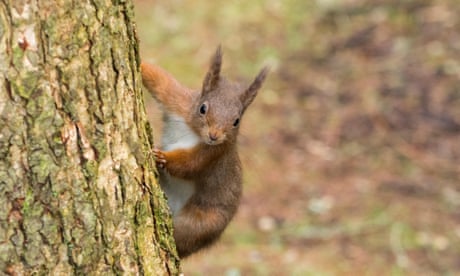
Grey squirrels are an invasive species in the UK, originally brought in as ornamental animals to decorate the grounds of stately homes. Photograph: Niall Carson/PA

Oral contraceptives could help reduce grey squirrel numbers, research finds

This article is more than 2 years old

British scientists say trial shows the nonlethal method could help eradicate the invasive species and allow red squirrels to recover

Oral contraceptives for squirrels are working, research has found, and the government hopes they can be used to keep populations down in the UK.

Grey squirrels are an invasive species in the UK, introduced from North America in the 1870s. They pose a problem for wildlife including endangered red squirrels, which they outcompete. They also carry a disease called squirrelpox that does not affect them but can kill reds.

They were originally used as an ornamental species to decorate the gardens of stately homes, before the damage they caused was realised and their release was banned in the 1930s.

Grey squirrels are also a menace to trees, stripping their bark and weakening them. They are a particular problem for broadleaf varieties including oak, which are ecologically important because they support so many other species. It is estimated that the UK is home to around 3 million of the invasive rodents.

Scientists have been trying to find ways to keep the grey population down, and now positive results have been released by the UK Squirrel Accord after a trial of oral contraceptives, which could be used to stop the mammals breeding.

The contraceptive is in production by the Animal and Plant Health Agency (Apha), with further tests being carried out to ensure it is safe and effective.
To stop other species ingesting the medication, scientists have designed a special feeding hopper. It has a weighted door that will exclude most other species of wildlife while allowing more than 70% of local grey squirrel populations to access and eat from them.

Apha is testing different methods of keeping red squirrels out of the feeders so that the contraceptives can be put in place in areas where there are both types of squirrel. So far, research suggests that body weight could be used to distinguish between greys and reds. No oral contraceptive has been used in the field at this stage of the research.

The environment minister Richard Benyon said: “The grey squirrel is an invasive species that is causing untold damage in the British countryside, where these pests continue to wreck our fledgling broadleaf trees like oak by stripping bark and disrupting the delicate balance of nature and biodiversity, whilst diminishing our ability to tackle climate change.

“That’s why we continue to support the UK Squirrel Accord and Apha as this important research on oral contraception shows promising signs that could help to eradicate the grey squirrel in the UK in a nonlethal way, as well as helping to recover our beloved red squirrel.”

Other methods that have been used to attempt to reduce grey squirrel numbers include the release of pine martens into certain woodlands. These predators scare off and eat grey squirrels. However, the shy martens would not colonise the urban areas that are grey squirrel strongholds, so as long as woodlands continue to be topped up by grey squirrels from the city, other methods – including contraceptives – will be needed to keep populations down.

Gideon Henderson, the chief scientific adviser at the Department for Environment, Food and Rural Affairs, said: “Fertility control can be an effective method complementing other approaches to wildlife management. This … study aims to produce an immunocontraceptive that can be orally administered to grey squirrels through a species-specific delivery mechanism.

“This innovative research has great potential to provide an effective, easily applied and nonlethal method for managing grey squirrel populations. It will help red squirrels – native to the UK – expand back into their natural habitats, as well as protecting UK woodland and increasing biodiversity.”

Factual journalism, for Germany and for the world

There has never been a more important moment for rigorous, fact-checked journalism.

Around the world, some of the most powerful figures: from politicians to billionaire business leaders have declared war on facts in order to shape the world to their own political and financial interests. 

There has been no clearer example of this than Elon Musk’s pro-AfD interventions ahead of February's critical election. 

If you care about the importance of access to facts and the protection of the public square, one of the easiest ways to defend it is by supporting independent, global-facing journalism.  

We know that many of our readers in Germany have a deep interest in international news – and that for many of you, the Guardian is a crucial resource. 

The Guardian is a global organization that shares this global perspective. Whether you’re reading in Leipzig or London, our international approach – with teams on three continents and reporters across five – means readers are able to follow live news around the clock and explore the global themes that affect us all.

With many media companies owned by a handful of huge corporations, it’s important to mention that the Guardian is owned by a trust, not a billionaire. 

This means we have been able to put vital issues such as the climate crisis and the rise of the far right at the centre of our reporting. The Guardian’s unique reader-funded model helps us to tell the global stories that matter to Germany and – with a crucial election ahead – to tell stories about Germany to the globe. We would be so grateful if you could join us today. Become a Guardian supporter today and support our international coverage. The most impactful way to do so it with our All-access digital subscription which offers unlimited app access, and other benefits.

Recommended
Accepted payment methods: Visa, Mastercard, American Express and PayPal

Related stories

Related stories

  • Colombian tree frog found by Sheffield florist highlights invasive species threat

  • Asian hornet may have become established in UK, sighting suggests

  • Asian hornet likely to have become established in UK, say experts

  • Raccoon dogs may be Britain’s next non-native pest, study finds

  • Red list research finds 26,000 global species under extinction threat

  • South Georgia declared rat-free after centuries of rodent devastation

  • Red list: ash trees and antelopes on the brink of extinction

  • Red squirrels: 5,000 volunteers sought to save species – and help kill invasive greys

More from Headlines

More from Headlines

  • Europe live
    Ukraine can maintain frontline, says its PM, after Trump puts military aid on hold

  • US politics live
    Major US retailers warn Americans will pay more because of Trump’s trade war with top partners, report says

  • Serbia
    Serbian MPs set off flares and smoke grenades inside parliament

  • Science
    Scientists aiming to bring back woolly mammoth create woolly mice

  • Middle East crisis live
    Arab leaders consider Egypt’s plans to clear rubble and bombs and rebuild Gaza Strip

  • Donald Trump
    Trump to lay out second-term vision in key address to Congress

  • Technology
    Taiwan vows most advanced tech will not go to US under $100bn Trump deal

  • Politics
    UK MPs condemn ‘deeply disrespectful’ JD Vance comments

  • Cricket live
    India v Australia: Champions Trophy semi-final

  • Australia
    ‘Man with the golden arm’, whose rare blood saved 2.4m babies, dies at 88

Most viewed

Most viewed